Showing posts with label gardens. Show all posts

Friday, January 20, 2012

Eating wild L.A.: Foraging with Transitional Gastronomy

Toyon berries are vaguely cherry-tasting and can be made into jam or put in baked goods
Even before Noma restaurant and foraging TV shows were in vogue, I've wanted to find out what's edible along local trails. I didn't think I could figure it out by myself, so I was happy to be invited to try a Foraging Foodies class with Transitional Gastronomy
Mia, left, tosses chickweed salad while Pascal points out wild pickles

Mia Wasilevich is the foodie part -- she finds ways to make wild foods taste great, while Pascal Baudar is the foraging part -- the Belgian native grew up learning wild foods while rambling in the forest, but he's lived in L.A. for years and knows our foodshed well, especially desert plants. We met up up in La Canada's Hahamongna Park, known to generations of Tom Sawyer campers as home of the one-eyed monster tunnel, but also home to a veritable salad bowl of easily-accessible edibles. Easy, that is, if you have some guidance -- don't be fooled by poison hemlock, which looks surprisingly similar to carrot tops escaped from a vegetable patch. 
Pascal touches nettles without gloves, but you shouldn't
Pascale showed a group of about eight of us (GourmetPigs was there too) how to find and distinguish chickweed, a rampant weed salad green with a grassy taste; stinging nettles, a trendy ingredient at top restaurants that are easily found for free (bring gloves!), toyon berries and wild sage. Many wild plants are also useful natural remedies, of course, and he pointed out black nightshade, a good remedy for the stinging nettles (oh yeah, it turns out deadly nightshade isn't actually deadly, and the berries can be made into ketchup!) and horehound, which can be made into cough-soothing candies. 
Pickled yucca shoots and radish pods
We gathered bags of chickweed, nettles and fragrant sagebrush and white sage, and returned to the picnic area, where Mia was cooking up acorn burgers on a bed of nettle puree, served with chickweed salad with toyon berry dressing, pickled acorns, radish pods, black walnuts and yucca shoots and mugwort and nettle beer. Once nettles are cooked, the stingers completely disappear and they make a vivid emerald puree that can be used like pesto or spinach. The acorn burgers had a chestnut-like sweetness and starchiness and were delicious and filling. Mia and Pascal gathered the fat acorns in the Angeles Forest (not the skinny ones you get at lower elevations) and boiled them several times to remove the bitterness. The tangy beer was much tastier than I had expected, since it's made with just nettles and yeast (maybe a little sugar?) -- no malt or hops. 
Classes in foraging and cooking are offered most Saturdays for $65, while Pascal offers other workshops like Beer with Wild Plants and Basic Trapping (great if you want to catch your own rabbit or quail!) through his Urban Outdoor Skills. Hopefully I'll never need to survive on chickweed and gophers, but it's a good feeling to know what might make a nice snack while others hike right past it and then buy arugula at the store.

Saturday, August 21, 2010

Santa Inez Valley: Wine, garlic and Santa Barbara squid

Full of Life exterior
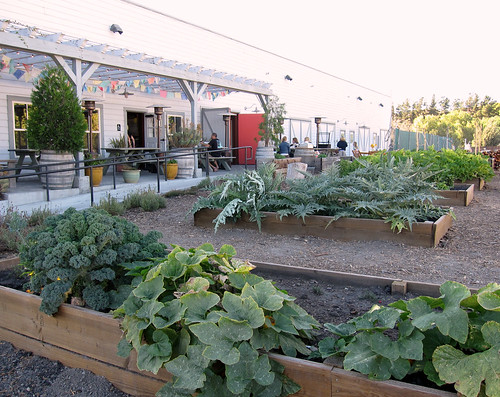
 Full of Life Flatbread's vegetable garden

I'm not sure why I hadn't ever stopped in the Santa Inez Valley on my way up Highway 101, but I suspect it had something to do with the presence of restless children packed into the backseat among loads of camping gear, and the need to get to Big Sur by sundown. Last week I skipped the annual Big Sur camping trip for a closer weekend in Los Alamos, Solvang and Los Olivos, and it's really one of the best close-by getaways there is -- especially if you like wine. Here's some worthy stops between Santa Barbara and Los Alamos.
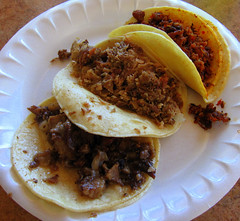
 Lilly's tacos
In Santa Barbara, nearly everyone in town was in line at La Super Rica. I've been there a zillion times, so we tried Lilly's instead. Lilly's is a very basic taco place hard by the 101, with a specialty in more obscure cow parts like lip, head and eye. Matt braved the tacos de ojos ($1.40 each, bottom in photo) -- "a little slimy, not bad with salsa," he reported, while I enjoyed the pork adobada. Lilly's isn't much different from eating in Highland Park, but it's probably the only place in Santa Barbara to eat for $3.00 and makes an easy lunch stop.
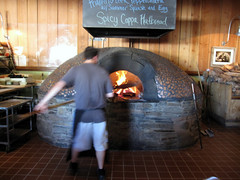
 Flatbread oven, Full of Life
We stayed at the Skyview Motel in Los Alamos -- it's pretty basic, but super reasonably-priced and has a pool, rec room with a pool table, generous free breakfast on weekends and it's walking distance from Full of Life Flatbread, the main attraction in tiny Los Alamos. It's only open for dinner on weekends, but Full of Life is well worth a stop for its flatbread pizzas cooked in a giant woodburning oven.
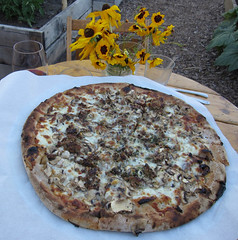
 Full of Life sausage flatbread
There's plenty of outdoor seating or toasty tables near the oven indoors, and the restaurant has an excellent local wine and beer list. We ate in the middle of the restaurant's garden, ordering Santa Barbara squid roasted in the oven and a salad from the restaurant's garden along with a Central Coast sausage and cheese flatbread. The thin, chewy flatbread uses coarsely-milled organic flour for an extremely flavorful crust marked with browned bubbles.
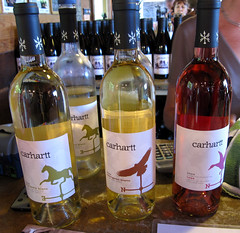
Carhartt tasting room, Los Olivos
The next day we explored the beautiful area around Los Olivos, Solvang and Lompoc. In Los Olivos, you can get a tri-tip sandwich at the Los Olivos Grocery or pick up picnic supplies for later. We stopped in at the Carhartt tasting room -- the tasting room is tiny, but a shady garden out back accommodates several more people, and it was lovely relaxing by the fishpond while winemaker Brooke poured samples. The $10 tasting fee was waived because I just had to pick up a bottle of the Pinot Noir and one of the rose.
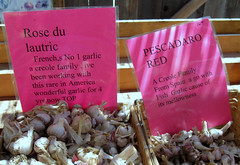
 Los Olivos Homegrown garlic
In Los Olivos, don't miss Homegrown Garlic on the main drag, a stand where Paul Poulmer grows and sells over 60 varieties of garlic. We choose Rose du Lautric and Belarus varieties to take home.

Aebelskivers, Solvang
Solvang was hot and touristy, but we made a quick stop for Danish aebleskivers, the freshly-made cross between a donut and a pancake that are irresistible with raspberry jam. It was there I invented a new rule for trips: When you see a local specialty being made on the street or served through a window on the sidewalk, it's always best to try it, or you'll be thinking about it the rest of the trip. We didn't stop at the ostrich farm in Solvang, but it might be a fun stop if you've got kids or want to buy some ostrich eggs or meat.
Alma Rosa tasting
Alma Rosa Winery feels like it's in deep countryside, but it's really just a few miles outside of Buellton on the way to Lompoc. The winery is owned by Richard and Thekla Sanford, who started one of the very first wineries in the area back in 1981. They're now producing all organic wines at Alma Rosa, where the rustic tasting room and patio seems far removed from noisy L.A.
Classic Organic Farm
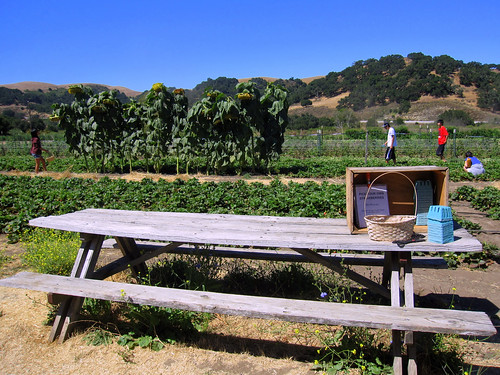
On the way home, we stopped at Classic Organic in Goleta, a wonderful farm stand with pick-your-own strawberries, uber-fresh eggs in  every pastel shade and lots of other fruits and vegetables. The strawberry I stole from a sun-warmed plant was probably the best I've ever had, and I was glad to have the organic eggs when I returned home to find out my Trader Joe's eggs had to be trashed due to the recall. Whether you go to taste wine or just check out the garlic and flatbread, the Santa Inez valley is really close and fun to visit.

Thursday, May 06, 2010

Urban Homestead on Private Chefs of Beverly Hills Friday


Check out the reality soap opera "Private Chefs of Beverly Hills" Friday night at 10 pm on the Food Network. It was shot at the Path to Freedom Urban Homestead, and among the diners trying out a vegetarian meal from the garden are Good Food's Evan Kleiman, author Amelia Saltsman, the L.A. Times' Jessica Gelt and me.
When we taped the show in January, it was a freezing cold, drizzly afternoon, but we enjoyed our lunch cooked by chefs Brian Hill and Manouschka Guerrier, which included fresh duck eggs, preserves from the Dervaes family pantry (below) and lasagna from the clay oven (above). The Dervaes family grows 6,000 lbs. of produce a year on their small urban lot near downtown Pasadena, and raises bees, chickens, ducks, rabbits and goats. It's an inspiring place even for air conditioning-using meat-eaters like me, and we learned a lot from chatting with the Dervaes family about why their vegetables have such intense flavors (it's the soil, of course) and lots more. If you want to know more about the homestead, check their blog and Facebook page. (For a family that uses olive oil to light their house, they're pretty plugged in.) 
(photos by Anais Dervaes)

Monday, February 15, 2010

Forage: Everybody goes to Sunset Junction

Forage is just about what been wishing for in Silver Lake restaurant: Informal, fresh, local and healthy. But be careful what you wish for: You might get it, but not be able to afford to eat there as often as you would like. It's only been open about two weeks, but thanks to Facebook, Twitter and blogs, it seems like practically everyone has already been in to try it.
I was excited that Forage was planning to offer locally-sourced foods; even better, chef Jason Kim will accept food from your yard and incorporate it into the dishes. (Drop by on Sunday afternoons with your produce; don't just show up with it at dinner time.)
One friend of mine even thought you had to bring your own food, and was worried that her garden only held a few stalks of arugula at the moment. But don't worry, it's really not a requirement to come bearing smogfruit, as we call our urban lemons.The only protein at lunch was roasted chicken, which I eat way too much of already, so I tried the quiche with two vegetable dishes. Everyone else was getting the pork belly sandwich ($9.50), which sounds decadent, but I had to repent after a deli special banh mi the day before.
Everything was bursting with flavor -- the bite of bitter arugula paired with bright citrus and beets; long-roasted fennel slicked with plenty of olive oil; a quiche packed with flavorful greens and a flaky crust. We also tried an equally flaky cheese straw and tabbouleh-style quinoa. Baked goods look wonderful too, especially a savory beet green tart and sticky toffee pudding.
At dinner, there's more to choose from, including scalloped potatoes, Heirloom beans, meatballs and pork enchiladas. ($9.75) All this deliciousness comes at a fairly high price, at least for lunch -- $13 for chicken and two sides, $10.50 for three sides, $20 for a roast Jidori chicken to take home.
Forage is closed Monday and open 11-3 for lunch and 5-9 for dinner Tues.-Sun.

Pros: Good selection of vegetable dishes, everything perfectly cooked.
Pleasant folks.
Blue Bottle Coffee!
Cons: No iced tea at lunch, one of my pet peeves at lunch places.
My friend wants me to add "No Equal for coffee."
$2.75 coffee served in paper cups.

Forage
3823 W. Sunset Blvd.
Silver Lake
(323) 663-6885

Forage on Urbanspoon

Saturday, February 06, 2010

Silver Lake Farms: Fight for your right to grow fruits and flowers

The kale I got at my Silver Lake Farms gardening class is finally ready to eat, too! (photo LATimes/AP)

Silver Lake Farms' right to grow flowers and fruits for sale in the city of L.A. was spotlighted today on LATimes.com as well as nationwide via Associated Press. Go Tara! Currently, the 60 year old law is written to allow growing only vegetables for sale. Ah, but where do tomatoes fall? As Kolla says, it is really odd when the city of Los Angeles has made it easier to grow marijuana for sale than strawberries, or easier to open a pot clinic than a coffeehouse or bakery.
As to whether Kolla should be conducting business in a residential neighborhood, there area plenty of parking and business tax statutes that regulate that area already without arbitrary yes to lettuce, no to flowers laws.
Go to Urban Farming Advocates to learn more about the fight to keep the city of L.A. growing and supporting sustainable business.

Thursday, January 21, 2010

Urban gardens help feed and green L.A.

Bikes and tamales make a good combo at Mama's Hot Tamales near MacArthur park on the Urban Expeditions ride.

EatingLA doesn't only go on taco and lahmajune bike rides, but we do like it when there's some kind of food connection. So I joined up with the Urban Expeditions Urban Garden ride Saturday, sponsored by C.I.C.L.E., which is working to make biking easier around Los Angeles. Around 60 cyclists turned out for the ride which looked at several types of gardens and green spaces mostly around Koreatown. Starting from the Bicycle Kitchen, our first stop was the lush Rosewood Community Garden, where urban gardeners utilize everything from discarded kids' race car beds to wheelbarrows. Next we got to see the Eco-Village, a cooperative community based in a group of apartments on Bimini Place, with abundant gardens, chickens, grey water recycling, artworks, and above, a solar oven.

Next stop was Bimini watershed park, where community organizers convinced the city to close Second St. and let the naturally occurring stream run through a small park instead of burying it. At the Francis Ave. community garden, south of Wilshire, members of the garden grow traditional Mexican medicinal herbs, fruit trees, and vegetables, and they've also made room for a shady barbecue area where neighbors hold community meetings and children can play. We finished with tamales at Mama's Hot Tamales, which often utilizes ingredients grown by local gardeners, and then a quick stop at a private garden where apartment renters turned their small backyard into an ample food-producing area with composting, a pleasant pergola and several raised beds. This was an inspiring glimpse at what L.A. city dwellers can accomplish to green their neighborhoods and eat the results, and thanks to Joe Linton and CICLE for organizing it.

Friday, August 28, 2009

Gardening 101: EatingLA gets some green-thumb help

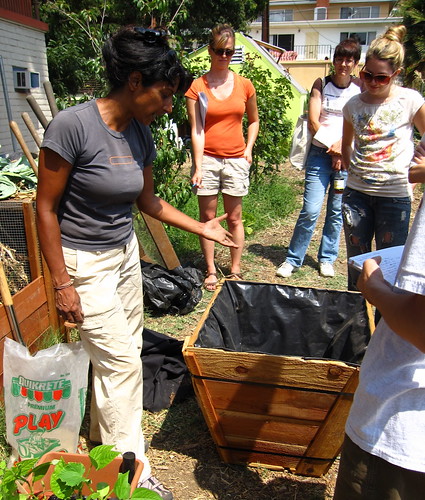
a good-sized planter box
Tara demonstrates why it's best to start with a good-sized planter box instead of several smaller pots.

Every so often I mention my struggling patio garden, which yielded just one (admittedly delicious) heirloom tomato this year. I realized that even growing in just a few pots, it might be a good idea to actually learn something about what I was doing, so longtime friend Tara Kolla of Silver Lake Farms invited me to take one of her gardening workshops at the Franklin Hills Community Garden.
In just three hours, I learned a lot about what I was doing wrong. I have just one word for you: soil. Tara gave us her optimum soil recipe, the number of a guy in Pacoima who makes incredibly cheap redwood planter boxes and much more info from her hard-won experience.
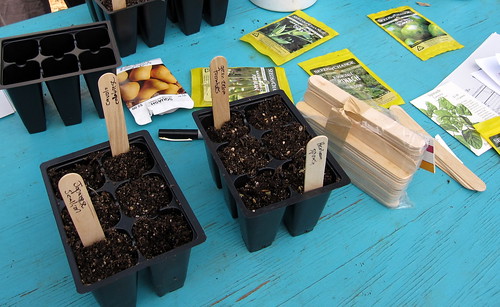
planting seeds
We even got to take home seedlings to start.
I even learned how to knowledgeably throw around terms like cotyledon, worm castings and legume inoculation. I'm sure this is very elementary for more experienced gardeners, but I've been planting things for many years without really knowing what I'm doing, and this class made me finally feel like I'm on the path to a decent garden. Although I rushed out to buy soil amendments after finishing this class, I'm guessing I'll end up spending less in the longrun on failed planting experiments and gimmicks.

Friday, August 07, 2009

Farmer's markets can be sexy!

Tara from Silver Lake Farms sent me this pic of a racy tomato grown by her friend Sabrina. Tara says "Sabrina grows the most perfect, gorgeous, exotic vegetables; each one is like an art piece. She sells at the Echo Park and Highland Park farmers' markets."

I wish I could say the same about my poor tomato. Yes, that's singular. The Prudens Purple tomato plant I bought at the Garden Show grew just one tomato, which I plan to eat this weekend. All the other flowers withered and died. At least it's a big one.
I did grow a few decent Romas, but basically, I guess I should stick to basil.

Tuesday, August 04, 2009

Farming for urbanites: summer workshops from Silver Lake Farms and Homegrown Evolution

Want to grow more of your own food? Or learn to make jam or recycle your water? You can't get any more local than harvesting food and preserving food from your own backyard. Both Silver Lake Farms and Homegrown Evolution have lined up a series of workshops to help citydwellers go a little more country.

At Silver Lake Farms August workshops, which take place at the Lila school in Los Feliz, choose from How to Keep a Vegetable Garden, Good Soil or Compost at $48 a class, or learn by working on an urban farm for free.
Silver Lake Farms is also launching a CSA this fall, so check the website for more info.
***
At Homegrown Evolution's August and September workshops ($40 and $50) in Silver Lake, learn about Seed Saving, Drip Irrigation, Greywater, Low-sugar Jam making and Summer Fruit Tree Pruning.

Sunday, June 28, 2009

Fraser imagines Red Wattle pigs in Echo Park

Michael Cirino demonstrates How to Cook an Egg, molecular gastronomy style, in a groovy Italian "slow food" kitchen, whatever that is.

Dwell on Design had a day of food events Sunday, including the Gestalt of Meat panel with panelists including Sasha Wizansky, founder of Meatpaper and chef Neal Fraser. There was talk of the art of meat but also of raising more sustainable meat. Fraser, who is perhaps not too familiar with zoning laws, lightheartedly imagined an idyllic day when "Red Wattle pigs would be raised in Echo Park, sold at the Silver Lake Farmer's Market and cooked at a restaurant in Los Feliz." Moderator Evan Kleiman pointed out that one problem with supplying more locally-raised meat is that years ago more than 200 slaughterhouses served the country, and now there are only 13 (at least if "Food Inc." is correct). How we subsidize calories -- whether with cheap food that causes health problems or with more costly but more healthful food -- is a societal decision, Kleiman says.

Bring the garden right to the table in this dining room table-cum-kitchen garden.

The Social Media panel was a little disappointing -- It was mostly about how Kogi BBQ and Twitter happened at actually the right time to feed off each other. The Kogi guy brought a spiffy powerpoint to show off Kogi's marketing chops, saying that fans help the trucks avoid parking tickets by finding good places for them to park. But I did like his idea of food trucks helping eaters explore the city through food, making eating out more of an adventure. Freya Estreller from the Coolhaus truck talked about how design can improve your eating experience, but I guess I'm not really convinced that it can. The sandwiches are clever, though -- Louis Kahntaloupe is the latest flavor.
Wooly Pockets, made from recycled plastic bottles, are a bit pricey at $249 for this large size, but make it easy to garden anywhere, even on walls.

I liked the Cultivating Gardens in the City panel too, which talked about the illicit thrill of guerrilla gardening for teenagers, seed bombs and how people change their eating habits when they grow their own foods. Here's a few things I learned at the Gardens panel:
The Public School is a collection of free or nearly free, esoteric and fascinating artsy and practical classes held Downtown and around the city.
The Theodore Payne Foundation offers a three-session class to help you design your entire yard by yourself with native plants.
HeartBeet Gardening is sponsoring a hyper-local CSA for the Larchmont area; it will be very cool if this idea takes off in other areas.

Saturday, May 02, 2009

Vegetable garden tips at the L.A. Garden Show

The greenest celeb, Adrien Grenier, checks out Dwell by Design's garden.

I'm glad the L.A. Garden Show, which continues through Sunday at the Arboreteum in Arcadia, went with the Festival of Flavors edible landscape theme this year, since that's what everyone seems to be interested in these days. I wanted to check out some of the home garden displays and pick up a few heirloom tomato plants. Since it was an outing with our friends from L.A. Stories, a kids' activities blog, it was a quick tour around the gardens and then on to the ducks and peacocks by the Arboreteum lake. Here's a few ideas we saw for home gardeners.
Paul Borden's patio garden box is made from recycled pallets filled with herbs, flowers and vegetables for growing a lot in a small space.

Laramee Haynes' design revolves at waist level and is designed so wheelchair users can easily garden.

Brightly-painted chicken coops are the chic backyard accessory du jour.