Showing posts with label DIY. Show all posts

Friday, January 20, 2012

Eating wild L.A.: Foraging with Transitional Gastronomy

Toyon berries are vaguely cherry-tasting and can be made into jam or put in baked goods
Even before Noma restaurant and foraging TV shows were in vogue, I've wanted to find out what's edible along local trails. I didn't think I could figure it out by myself, so I was happy to be invited to try a Foraging Foodies class with Transitional Gastronomy
Mia, left, tosses chickweed salad while Pascal points out wild pickles

Mia Wasilevich is the foodie part -- she finds ways to make wild foods taste great, while Pascal Baudar is the foraging part -- the Belgian native grew up learning wild foods while rambling in the forest, but he's lived in L.A. for years and knows our foodshed well, especially desert plants. We met up up in La Canada's Hahamongna Park, known to generations of Tom Sawyer campers as home of the one-eyed monster tunnel, but also home to a veritable salad bowl of easily-accessible edibles. Easy, that is, if you have some guidance -- don't be fooled by poison hemlock, which looks surprisingly similar to carrot tops escaped from a vegetable patch. 
Pascal touches nettles without gloves, but you shouldn't
Pascale showed a group of about eight of us (GourmetPigs was there too) how to find and distinguish chickweed, a rampant weed salad green with a grassy taste; stinging nettles, a trendy ingredient at top restaurants that are easily found for free (bring gloves!), toyon berries and wild sage. Many wild plants are also useful natural remedies, of course, and he pointed out black nightshade, a good remedy for the stinging nettles (oh yeah, it turns out deadly nightshade isn't actually deadly, and the berries can be made into ketchup!) and horehound, which can be made into cough-soothing candies. 
Pickled yucca shoots and radish pods
We gathered bags of chickweed, nettles and fragrant sagebrush and white sage, and returned to the picnic area, where Mia was cooking up acorn burgers on a bed of nettle puree, served with chickweed salad with toyon berry dressing, pickled acorns, radish pods, black walnuts and yucca shoots and mugwort and nettle beer. Once nettles are cooked, the stingers completely disappear and they make a vivid emerald puree that can be used like pesto or spinach. The acorn burgers had a chestnut-like sweetness and starchiness and were delicious and filling. Mia and Pascal gathered the fat acorns in the Angeles Forest (not the skinny ones you get at lower elevations) and boiled them several times to remove the bitterness. The tangy beer was much tastier than I had expected, since it's made with just nettles and yeast (maybe a little sugar?) -- no malt or hops. 
Classes in foraging and cooking are offered most Saturdays for $65, while Pascal offers other workshops like Beer with Wild Plants and Basic Trapping (great if you want to catch your own rabbit or quail!) through his Urban Outdoor Skills. Hopefully I'll never need to survive on chickweed and gophers, but it's a good feeling to know what might make a nice snack while others hike right past it and then buy arugula at the store.

Friday, December 23, 2011

Pat's not-too-sweet, not-too-expensive kinda healthy best granola

Pat's granola
Homemade cherry/cranberry/walnut granola
(inspired by David Leibovitz and Nigella Lawson)
A few months ago I suddenly started craving really good granola, the kind that's usually $8 for a small bag and a zillion calories. I hadn't made my own granola since the Campanile recipe was popular for years, but I remembered it was usually expensive to assemble all the ingredients and so rich it was tempting to eat the whole recipe as a snack, leaving nothing for breakfast.
I started with David Leibovitz's recipe, which is in turn inspired by Nigella Lawson, and simplified it a bit. The key is applesauce or pear sauce, which provides sweetness and adds crunch. Unlike Mark Bittman's recipe, there's a bit of fat, which I feel is necessary to make it crunchy and carry the flavor, though less than Campanile's version.
From there I decided that 3 cups of almonds would probably add more calories than I need, plus they're expensive. So I use a half cup of walnuts, but really you can use whatever you want. I don't use the sesame seeds at all, I don't think it suffers without them. I also cut out the rice syrup, because there's already enough honey and brown sugar, and I'm sure it's costly as well. I add a quarter cup of ground flax seeds to make it a bit healthier, and some dried fruit. I use a half cup of dried cranberries and a half cup of dried cherries, but chopped dried apricots are also great, and Nigella prefers raisins.
David uses two tablespoons of vegetable oil. This time I used three tablespoons of coconut oil, which in one of those confusing nutritional switcheroos, is now considered more healthful than canola oil instead of less. I think it strikes a good balance of not too costly, a little addictive but not too, and relatively healthy. It's great mixed with plain Greek yogurt or Go Lean cereal and soy milk. You could also whip some up quickly for Christmas presents.

Here's my tweaks to David's recipe:

Pat's Not-too expensive, Not-too-sweet Kinda Healthy Best Granola

5 cups old-fashioned rolled oats (get it in bulk at Whole Foods or in the bag at Trader Joe's)
1/2 to 1 cup coarsely chopped walnuts or almonds
1 cup sunflower seeds (Whole Foods bulk bins)
1/4 cup ground flax seeds (available at TJ's)
1/4 cup packed light brown sugar (use more or less depending on your sweet tolerance)
2 teaspoons ground cinnamon
1 teaspoon dried ground ginger
1 teaspoon sea salt
3/4 cup unsweetened applesauce or pear sauce (available in single serve cups at Trader Joe's)
1/4 cup honey
2-3 tablespoons vegetable oil (coconut oil, now available inexpensively at TJ's, makes it even better.)
1 cup chopped dried cranberries, cherries, apricots and/or raisins)
Preheat the oven to 300F.
1. In a  large bowl, mix together oats, nuts, sunflower seeds, brown sugar, cinnamon, ginger, and salt.
2. In a small saucepan, warm the fruit puree with the honey and oil.
3. Mix the fruit mixture into the dry ingredients until thoroughly dispersed, then divide and spread the mixture evenly on two baking sheets. (If you have ones with sides, often called jelly-roll pans, use them.)
4. Bake the granola for about 45 minutes, stirring every ten minutes, until the granola is deep golden brown.
5. Remove from oven, add chopped dried fruits, then cool completely. Try not to eat it all the first day.

Wednesday, September 09, 2009

Making kimchi is easier than you would think

Granny Choe lays out kimchi ingredients: Nappa cabbage, onions, mustard greens, daikon, ginger, garlic, chile powder, sugar, salt.

Machine Project hosts some of the best food events, usually at really affordable prices. With Boingboing's Mark Frauenfelder and Homegrown Evolution's Kelly Coyne and Eric Knutzen organizing with an assist from SlowFoodLA, the Krautfest 2009 was destined for cabbagey awesomeness.
Here's Mark's report on BoingBoing. I couldn't make the kraut part, so I showed up to learn how to make my own kimchi.
Kimchi expert Granny Choe and her daughter showed us how it's done.
  • The night before, you have to submerge the leaves from a Nappa cabbage in salted water. The next morning, you drain them.
  • Slice them up into about 1" slices into a large bowl. Now mix in some chopped scallions or onions, a cup of chopped mustard greens and a handful of shredded daikon if you like.
  • Pound or pulverize an entire head of peeled garlic cloves and mix it with about an inch section of grated ginger, two teaspoons non-iodized salt, a tablespoon of sugar, a tablespoon of pulverized cooked white rice and a cup of water. Pour that mixture over the cabbage.
  • Now pour in a cup of powdered Korean red chile pepper. You need to get this at the Korean market -- cayenne pepper or Mexican chile powder is not the right stuff.
  • Mix it all up, and it already looks like bright red kimchi ( above left). You can taste it, it's already pretty good before it even ferments. But you're not done yet. Like with yogurt or bread, you'll need some starter. Mix in a few tablespoons of kimchi from the store, or ideally from your last batch, to get the fermentation going.
  • Now put it into a closed container (a big jar like the one at right is good) and leave it in a kitchen cupboard for a day (maybe two if it's chilly out). Put it in the fridge after two days, and voila, you've got kimchi! It's pretty forgiving stuff -- you can try out all kinds of different ingredients, and it will last for quite a while in the fridge, getting more and more fermented. Granny Choe says it's the interplay of the chile, garlic and onions that makes the magical kimchi juice. I left out the pulverized rice and daikon, but mine tastes just fine.
Have you ever made kimchi? Did you do anything differently from this class?

This Saturday and Sunday is another great SlowfoodLA food workshop at Machine Project -- you can learn how to make bread and pizza dough Saturday, and then build a pizza oven and bake it on Sunday.

Wednesday, July 29, 2009

Artisanal homebrew kits: What the cool kids in Brooklyn are up to these days

Brooklyn Brew's Stephen Valand and Erica Shea

Here's an idea possibly ripe for an L.A. micro-entrepreneur to rip-off, I mean adapt: the Brooklyn Brew Shop sells at-home brewing kits at the Brooklyn Flea market and online in delicious-sounding flavors like Chocolate maple porter and Grapefruit honey ale. A $40 kit brews about gallon of beer and looks like an easy way to ease into homebrewing. They're also working on more flavors like Lobster beer (made with the shells, not the meat) and Bourbon Dubbel.
(via Village Voice's Fork in the Road blog)

Monday, July 27, 2009

Time for a jam session Sunday with Fallen Fruit

Fallen Fruit's 4th annual Public Fruit Jam is Sunday at Machine Project in Echo Park from 10-1 pm. Bring fruit you've picked or foraged (or bought if you're desperate), herbs and spices and empty jars to mix up some unusual jams. They're expecting a lot of people, so get there early, I guess, since Machine Project is tiny. "We encourage people not to follow recipes and think of it as a collaboration
between citizens of the same town," says Fallen Fruit.
Sunday, Aug. 2, 10-1; free; but bring fruit to contribute.

Sunday, June 28, 2009

Fraser imagines Red Wattle pigs in Echo Park

Michael Cirino demonstrates How to Cook an Egg, molecular gastronomy style, in a groovy Italian "slow food" kitchen, whatever that is.

Dwell on Design had a day of food events Sunday, including the Gestalt of Meat panel with panelists including Sasha Wizansky, founder of Meatpaper and chef Neal Fraser. There was talk of the art of meat but also of raising more sustainable meat. Fraser, who is perhaps not too familiar with zoning laws, lightheartedly imagined an idyllic day when "Red Wattle pigs would be raised in Echo Park, sold at the Silver Lake Farmer's Market and cooked at a restaurant in Los Feliz." Moderator Evan Kleiman pointed out that one problem with supplying more locally-raised meat is that years ago more than 200 slaughterhouses served the country, and now there are only 13 (at least if "Food Inc." is correct). How we subsidize calories -- whether with cheap food that causes health problems or with more costly but more healthful food -- is a societal decision, Kleiman says.

Bring the garden right to the table in this dining room table-cum-kitchen garden.

The Social Media panel was a little disappointing -- It was mostly about how Kogi BBQ and Twitter happened at actually the right time to feed off each other. The Kogi guy brought a spiffy powerpoint to show off Kogi's marketing chops, saying that fans help the trucks avoid parking tickets by finding good places for them to park. But I did like his idea of food trucks helping eaters explore the city through food, making eating out more of an adventure. Freya Estreller from the Coolhaus truck talked about how design can improve your eating experience, but I guess I'm not really convinced that it can. The sandwiches are clever, though -- Louis Kahntaloupe is the latest flavor.
Wooly Pockets, made from recycled plastic bottles, are a bit pricey at $249 for this large size, but make it easy to garden anywhere, even on walls.

I liked the Cultivating Gardens in the City panel too, which talked about the illicit thrill of guerrilla gardening for teenagers, seed bombs and how people change their eating habits when they grow their own foods. Here's a few things I learned at the Gardens panel:
The Public School is a collection of free or nearly free, esoteric and fascinating artsy and practical classes held Downtown and around the city.
The Theodore Payne Foundation offers a three-session class to help you design your entire yard by yourself with native plants.
HeartBeet Gardening is sponsoring a hyper-local CSA for the Larchmont area; it will be very cool if this idea takes off in other areas.

Saturday, May 02, 2009

Vegetable garden tips at the L.A. Garden Show

The greenest celeb, Adrien Grenier, checks out Dwell by Design's garden.

I'm glad the L.A. Garden Show, which continues through Sunday at the Arboreteum in Arcadia, went with the Festival of Flavors edible landscape theme this year, since that's what everyone seems to be interested in these days. I wanted to check out some of the home garden displays and pick up a few heirloom tomato plants. Since it was an outing with our friends from L.A. Stories, a kids' activities blog, it was a quick tour around the gardens and then on to the ducks and peacocks by the Arboreteum lake. Here's a few ideas we saw for home gardeners.
Paul Borden's patio garden box is made from recycled pallets filled with herbs, flowers and vegetables for growing a lot in a small space.

Laramee Haynes' design revolves at waist level and is designed so wheelchair users can easily garden.

Brightly-painted chicken coops are the chic backyard accessory du jour.

Monday, January 12, 2009

Making sauerkraut is easy, says Boing Boing

It's not mold, it's "bloom"! (via BoingBoing)

Although EatingLA only manages to cook an actual meal about once a week, we encourage readers to do better than that and also learn to make stuff yourself, darnit.
Here's Boingboing editor Mark Frauenfelder, who helped organize Machine Project's picklemaking, on making your own easy sauerkraut. I think I'm going to try kimchee soon, anyone done it?

Saturday, December 06, 2008

Good December: tamales, gardening, ice cream and more

All you need is three bowls of filling, plus husks, for cheese-jalapeno tamales

I signed up for the tamale-making class as the perfect excuse to get myself over to the Good December event sponsored by Good magazine. Although the workshop was a one-off, you should check out the space anyway, especially Sunday (Dec. 7) for the second day of the Local World's Fair. There's some very cool handmade stuff to buy, free Intelligentsia coffee, and other serendipitous things like the raw almond-butter workshop that started up while I was there. Silver Lake Farms, Full Circle Gardening, Evan Kleiman and others will be there Sunday, and there are other events revolving around sustainability, local activism and such every day for the next two weeks. And free Ben & Jerry's ice cream much of the time too.

Before the tamale workshop, sponsored by LA Commons and Mama's Hot Tamales, we feasted on tamales with mole and chile verde while we heard the inspiring story of Sandi "Mama" Romero and how she was instrumental in cleaning up MacArthur Park and helping sidewalk vendors go legal, as well as starting a business incubator program. One of her protegees, Ariceli from Mama's International Tamales, provided masa (made with vegetable oil instead of lard), jalapenos in tomato sauce, cheese and corn husks and showed us how to spread the masa (left), fold the husks, and then wrap it all in paper just like you swaddle a newborn. Mine were a little messy, but I'm sure after steaming for 45 minutes or so, they should be just right.
I like Good's mission "to push the world forward" targeted to "people who give a damn." Plus, they've figured out that the progressive messages go down easier with ice cream, coffee, tamales and lots of groovy people wandering around.

Tuesday, September 30, 2008

Last weekend for peach-picking!

Charles emailed to let me know that it's finally peach season in Little Rock. We had a great time picking cherries and I'll bet these peaches are wonderful too. Peach pie, anyone?
Here's the address for pesticide-free Yingst Ranch:
Yingst Ranch, 35349 80th Street East, Littlerock.
Closed Mondays, but open during the season from 8:00am until 5:00pm. For questions or to confirm availability, call 661-944-2425.

Saturday, September 20, 2008

Pickle-making: Machine Projects tells you how

These ambitious picklers even pickled some celeriac.

I got ready for the pickle-making workshop at Machine Projects Saturday by gathering some jars, buying some smallish pickling cucumbers and some carrots, and picking all the extra parsley and thyme in my garden. When I showed up, a few people were already cutting an array of vegetables. Kelly Coyne from Homegrown Evolution explained that we were making lacto-fermented pickles, which grow their own bacteria and ferment in a saltwater brine. There's no vinegar or sugar involved like the refrigerator pickles I had made in the past. Here's how to do it at home (click to enlarge).

There were spices like peppercorns. smoked paprika, zaatar and pickling spices lying around to experiment with, as well as extra garlic, cactus paddles and plenty of dill, of course. I had already cut up my carrots and blanched them, and Kelly wasn't sure they would grow enough bacteria that way, but she suggested trying anyway. More people arrived and most of the pickling stations were full, with people packing everything from red chard stems to lemons to eggplant into large jars and then adding an array of spices. My finished pickles complete with grapeleaves and herbs.

Kelly brought grapeleaves for us to put in with the cucumbers, which she said keeps the pickles crisper. In two weeks, if all goes well, I'll have two jars of tasty dill pickles and two of pickled carrots with garlic and jalapeno. This is a very easy DIY project, so give it a try and let me know how the fermenting goes.

Sunday, June 15, 2008

Cherrypicking in Leona Valley: Out of L.A. for the day

A branch laden with Rainier cherries
When Charles proposed a cherry-picking excursion to Leona Valley, I jumped at the chance to get out of town for a morning and end up with a few buckets of cherries to show for it. And when his friend Kirstin offered to drive her Prius, it really sealed the deal. Charles had been before, so he knew which orchards were pesticide free and where there might be sour cherries -- although that one was closed for another week or two. Check out the website for Leona Valley Cherry Pickers for a list of orchards. After about an hour's drive up the 14 freeway, we came to plenty of signs for various orchards, all in the $2.75 to $3.00 a pound range. Most of the trees are pretty low, so even little kids can get plenty, although some orchards also have ladders. It doesn't take to long to pick several pounds, but if you take some food for a picnic you can make a nice day of it. The orchards have restrooms and sell cherry pitter gadgets, hot dogs, honey, snow cones and such. After a marathon pitting session, we tucked into some lovely cherry cobbler for dessert. Tomorrow: cherry ice cream.

Wednesday, March 01, 2006

Here's a honey of a story

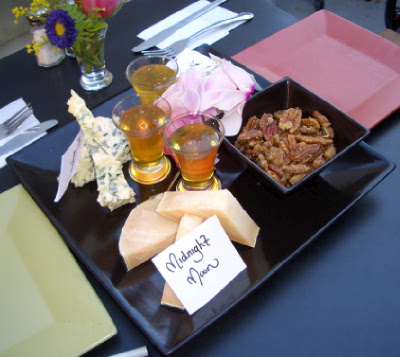
mmm, cheese with local honey...

My L.A. Times story on Mary Ellen Mason, who makes her own honey in Elysian Heights, came out today. You can read it here. First honey and then moonshine, I wonder what else is being made in Echo Park? In the picture above, you can see a lovely honey and cheese pairing that Mary Ellen arranged -- a nice thing to try at home, n'est-ce pas?

Sunday, February 12, 2006

Hooch in Echo Park, woo hoo!

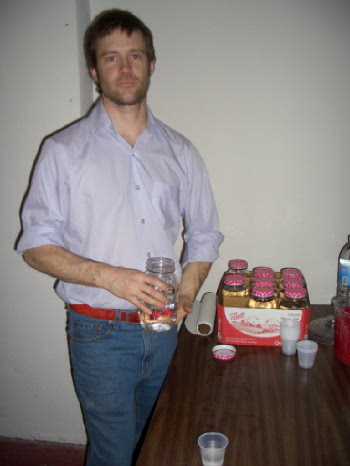
(Left, some fine Echo Park hooch)
Eating L.A., which is sometimes Drinking L.A. too, couldn't miss the demonstration of making corn whiskey in an Echo Park gallery. So Saturday night we checked out the Machine Projects talk where Alison explained why she wanted to build a still, and how to make corn whiskey. It seems considerably more complicated than brewing beer, which I gave up long ago along with making pasta and other labor-intensive pursuits. Samples were liberally distributed, and although I don't usually drink straight whiskey, I found it surprisingly tasty. It was much smoother than I would expect homebrewed hooch to be, providing a pleasantly warm feeling without any alcohol burn. I found about about Machine Projects through BoingBoing, which is fast becoming one of my favorite blogs. I used to think it was too hard to wade through all the geek-speak, but now I find it easy enough to quickly scan it for things non-computer programmers would be interested in, and there's always some good stuff on there.